Showing posts with label Gospell. Show all posts

Wednesday, May 15, 2024

CML Micro & Cambridge Consultants DRM1000 chip

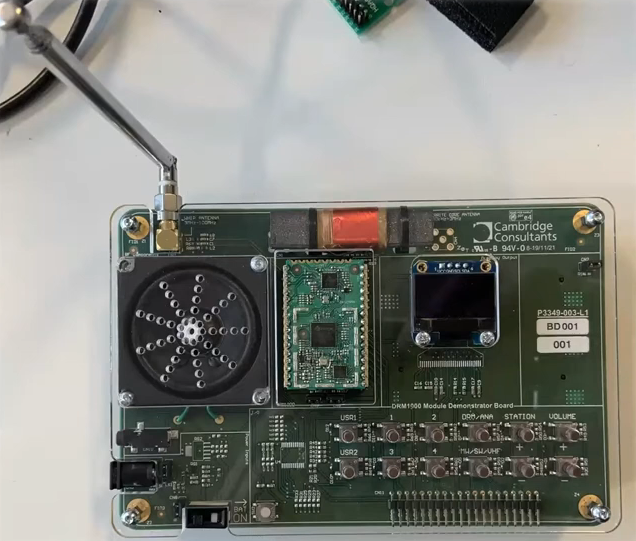
The newest press release here (the older press release is here). This is the chip Gospell is using in its new portable, the GR-221 (available soon). This looks to be a real game-changer due to it being an all-in-one solution,  having low power consumption (30+ hours on 3 AA batteries, including the possibility of a solar powered and cranked models) and its affordable cost (<$20 USD). It should yield a whole new crop of receivers that will be ideal for the burgeoning Asian DRM markets of China, India and Pakistan. Now all we need to do is to convince the North American shortwave broadcasters that the time has come for regular DRM broadcasting. Mouser plans to stock the chip soon. This novel DRM solution debuted at BES in February of this year.


Thursday, April 1, 2021

CNR DRM test schedule posted


While not particularly new information, we have confirmation of times and frequencies as well as a few things to be watching for. Undoubtedly this is why it has been reported that Gospell is in full production mode for their new receivers.

Via World of Radio, Takahito Akabayashi posted his findings from the following 

Original source: https://cahcn.github.io/drm/

Beijing
 2055-1805 6030 0 degrees 3FF (except Tue 0600-0900)
 0100-0900 13825 175 degrees 3EA

Donfang
 0100-0900 11695 41 degrees 3E8
 0100-0900 17700 16 degrees 3ED

Kunming
 0100-0400 15180 32 degrees 2
 0400-1100 13810 32 degrees 2

Qiqihar
 0000-0400 9420 203 degrees 1
 0400-1000 7360 203 degrees 1
 1000-1200 9870 203 degrees 1

Urumqi
 2200-0100 9655 98 degrees 3EC
 0100-0800 17830 98 degrees 3EC
 0800-1200 9655 98 degrees 3EC

Power listed as 30kW 

Additional test transmission using the HFCC registered CRI frequencies of Kunming transmitter site. Power 30kW, 135 degrees, transmission identification code 3F9.

 0100-0300 9730
 0700-0900 12030
 0100-0500 12090
 0300-0500 13655
 0500-0700 13715
 0700-0900 13775
 0500-0700 15615


Tuesday, June 9, 2020

New crop of DRM receivers from Gospell

I got this email today:

"Glad to hear that you're on the market for DRM Radio Receiver,we are a professional manufacturer in China, hoping to establish business relationship with you. In my following email, we recommend some of our hot selling products for your reference."

Accompanied by this link

HaoChun Liu @HCLiu11 (who should be familiar to many DRM enthusiasts from his work at Newstar and Gospell) showed off a few of these sets in Twitter teasers earlier in the year.

We reviewed the GR-216 several years back. I have no further information on these new sets, other than what I have seen on Twitter. I'm always glad to see new receivers on the market. Several of these are even battery powered, which is great news.

Monday, September 9, 2019

Gospell at IBC 2019 with new gear!


Gospell will once again represent at IBC in Amsterdam. Seen above is their long promoted but only recently released GR-227 car converter on the left. In the center is the new GR-22 portable. On the right is the veteran GR-216 which we thoroughly reviewed here.

Saturday, March 9, 2019

Receiver demonstrations at DBS 2019

Here we see a quick demo and information shared by Alexander Zink of the DRM Consortium at this week's ABU Digital Broadcasting Symposium held in Kuala Lumpur. He describes that the Gospell GR-216 is using the NXP automobile chipset. We see and hear the Titus II but without further details. Still waiting!

Saturday, February 9, 2019

China - DRM a breakthrough?

Great article on the rapid deployment of DRM in mainland China.

The article addresses the elephant in the room re: receivers, but this is the thing that could result in a tipping point for that problem. Read the RadioWorld article here.

Saturday, July 14, 2018

Chinese DRM!

As has been hinted at in the recent past, China may be on the cusp of a DRM broadcasting revolution.

This may represent the first in many broadcasts, which would certainly break the DRM market wide-open! Great opportunity for Gospell to capture the growing market -  as they have the only DRM receiver in current prodcution and they are located in China.

As seen on Now on the radio BBS "Jul 13, 2018 06:47 UTC CHINA: 6030kHz, Chinese traditional music
("Minzu Yinyue")(DRM) UTC 0230-0700?"

Sunday, May 27, 2018

Great fun at NASB 2018!


Good things were planned at SonSet Solutions in Elkhart, Indiana and those fine folks delivered!


Charles Jacobson served as Emcee and host for two days of fun and fellowship at SonSet, a partial continuation of the services that we all remember as HCJB. SonSet and ReachBeyond are now the heirs to this PRICELESS Shortwave legacy!


As usual, folks assembled from around the globe to discuss, reminisce and plan the future of Shortwave radio. I am always awed at the knowledge and experience of the various attendees. Representatives from all over CONUS and as far away as Asia and Europe were in attendance.

Presentations ran-the-gamut from news, receiver technology, new installations, antennas... the list goes on. Here are just a few highlights!


Charles gave an informative tour of the plant at SonSet Solutions. He then detailed projects including work with the SonSet Radio (a rather robust and efficient fixed-tuned ministry receiver).


Ever the popular presenter, Dr. Kim Andrew Elliott presented Digital Broadcasts on Analogue Shortwave Transmitters. He is the producer of "Shortwave Radiogram" and is recently retired from VOA. Dr. Elliot wowed the audience with live decodes (transmitted from WRMI and WWCR) of Shortwave Radiogram via a SonSet radio. Presentation of foreign characters (Cyrillic, Chinese and Arabic) really showed the power of this novel broadcasting technology!


Gerhard Straub Director, IBB Broadcast Technologies Division presented and engaging talk on International Broadcasting Bureau Shortwave Projects with continued good news about our CONUS powerhouse in Greenville, North Carolina.


Jerome Hirigoyen of Telediffusion de France (TDF) offered details of the 360-degree Rotatable Antenna System known as ALLISS. I'd take one for my house, but the neighbors might complain!


NASB is known for excellent food and our dinner at "Das Dutchman Essenhaus" in Middlebury, IN (an Amish style restaurant in the middle of Amish country) was tasty and great fun.

Of course, if you are reading this blog, you want to know about DRM! Well the news was plentiful and I'd call it GREAT! Both George Ross of TWR and yours truly presented on DRM topics.


George had more news about the Titus II receiver. It is nearly ready from prime-time and will be using Fraunhofer MMPlayer. This is great news and should make for a very versatile receiver. Although there have been numerous false-starts with the release of the Titus II, it is nearing release and is still promised at the sub $100 price tag.


In "fly catching mode" I am seen here presenting the DRM global update  and extolling the virtues of the Gospell GR-216.


After my presentation, we moved to SonSet's hamshack to attach the Gospell to an external antenna. We were then treated to an hour of nearly flawless reception of Radio Kuwait in DRM stereo! It was really a joy and attendees that had never experienced DRM were awestruck at the audio quality and signal clarity from so far away.


NASB members gave brief reports about their efforts. Of particular interest is the work that J.D Tayloe of Strategic Communications Group shared regarding reviving an old KOL Israel site.


The business meeting handled NASB elections and plans for 2019. The location wasn't finalized but should be shortly. Stay tuned! Another great NASB conference! Thanks to the host, SonSet Solutions for another memorable and informative meeting!

Monday, May 21, 2018

CONUS-wide Gospell GR-216 review!

Special thanks to Haochun of Gospell for the demo unit. As you will read below, we really put it through its paces. Haochun allowed us a test unit and this single radio was all over the USA in states from the West Coast to the East Coast in 6 months.

We were particularly fortunate to present the demo unit at NASB 2018 at SonSet Solutions in Elkhart, Indiana. Kuwait DRM came through for a solid hour on two frequencies from 7000 miles away! Here is a short clip as an example. If this doesn't convince you that we have a winner here, then nothing will!


It is a pity there is so little DRM available in North America. After our experience with Kuwait, the consensus is that the GR-216 works well overall and very well with DRM (remember, this is an early release with early firmware) and I believe it represents hope that tabletop DRM reception is now within reach!

Fibber:

I have been taking my time to enjoy the new GR-216. The unit is a full featured table top with traditional AM and FM offerings plus Shortwave and DRM (for AM and Shortwave bands). Build quality is really nice. It is a solid feeling radio, with a crisp looking LCD display. It sports BNC connectors for antennas and RCA and 1/8" jacks for audio output. It has a physical switch for using internal versus external antennas.

I'm going to quickly cover AM and FM reception. Here in the Pacific Northwest, DRM is just about non-existent currently. Shortwave reception is fair this time of year so here is an example of daytime VOA Korea.


On a quick trip to the Oregon coast, I caught this Classical music station transmitting full RDS. Nice to see the scrolling text descriptions on such a nice, bright display.


I did have several brief opportunities to compare signal levels on DRM brodcasts. Kuwait and Romania both presented on the radio, Kuwait with bits of audio. I ran these concurrently with a recent build of DReaM and found the Gospell comparable to what I was getting via the ELAD FDM-S1 using DReaM.

I must say that the variable AM bandwidths have quickly become my favorite feature. The wide settings are more than generous for high-fidelity listening. The medium and narrow settings provide the ability to avoid adjacent squawk in even the overcrowded 49M bands on my West Coast mornings.

If I had any suggestions with would variable AGC options for AM and possibly speaker modifications as the AGC seems to on-occasion clamp and then release on deep fades to big signals, causing physical speaker distortion or almost rattle even. No doubt some of the problem is simply a firmware adjustment.

This is by far the most stout and robust feeling DRM receiver I have encountered. Once the price-point approaches that of conventional (but high-quality) tabletops, we will have a global winner here. xHE-AAC compatibility on DRM too, so this one will be ready for my Global DRM Domination plan!

BRENDAN:

First Impressions: after the box arrived, I carefully pulled out all of the contents and studied the radio itself. Larger and heavier than the DR111, it has a sturdy plastic case and knobs. A separate 110V power supply with Euro-style pins had been sent along, but a pin adapter fixed that issue. Plugged it in and was greeted by the radio as it booted up. It worked!

But what kind of radio is this? Is it a geek's radio or a consumer's radio? It's a bit of both actually. You can choose to just set and use the memories and be happy, or manually tune it and listen to DX. With both internal antennas and BNC connectors for external ones, you can choose to use it as a tabletop receiver in the kitchen or living room.  Think of it this way: the looks of an MW/FM receiver, with a decent HF SDR receiver inside.

Build quality is something I'd like to talk about before my operating observations. The case is sturdy, but the knobs and buttons need a better mechanical foundation. They are wiggly when they're not supposed to be and feel cheap. The sub-assembly that the front control buttons are attached to is not very strong, since a single button push would move them all within their casing holes. All controls actually worked fine, so the electrical aspect was good, just not the structural assembly. The main tuning knob is used for several functions just like the DR111, but it too needs some work. It often overtunes (too fast), even in 'slow' mode, so manual tuning has to be carefully done, and the detents in the knob's action don't help either. There is an extensive frequency/channel memory system built-in, but I did not use it.

Operating the radio, I found not all controls to be entirely obvious, nor did the instruction booklet provide much help actually. I still don't really know what "VF/VM" means, outside of perhaps meaning "Visible Frequency/Visible Memory." Never did function that I could tell...

However, most of the other control functions were easy to understand and/or figure out, so I was able to get it working reasonably quickly. Analog FM reception is quite good, and I was pleased at the fringe reception results for my location. The GR216 has a good speaker, and you can separately adjust the treble, midrange, and bass using the button control commands, a neat touch (no extra knobs). Stereo outputs are available on the back plane, so you can connect the radio to an ouside stereo system. A 3.5mm headphone jack, 2 RCA connectors for both channels, and power inputs.

Analog MW/AM operation was very straight forward, and proved to be quite good with external antennas connected. The internal antenna was not that good in my experience, due to AC hum like I have not heard in years. The FM band was only somewhat affected by the hum, but the MW/AM band was virtually useless. Not even the local MW stations located only about 5miles/8Km away completely overwhelmed, making listening very difficult. Connect an external antenna and the noise disappears, WITH the same power supply. Hmmmm...

HF analog reception was good, especially with an external antenna connected, but the internal rod antenna was not that effective for HF purposes.

A very neat feature that works on all modes is what appears to be an automatic filter bandwidth  setting, and it works well. I could set the radio to FM, tune a local station which would then show a wide(r) bandwidth, while moving to what is a DX station showed a narrower width. Very effective, even on HF.

While I could not 'catch' any DRM signals during my review period, I have no doubt that the GR216 would work well, based on my previous experience with my own DR111. I would also rate the GR216 as a better all-around radio than the DR111, given the higher quality speaker and more refined operating controls.

In summary, I found the GR216 to be a good consumer-oriented radio. The bells and whistles that we enthusiasts like are there, but this is a radio even my 88 year mother could use once set up. She is not a tech whiz, and has difficulty with a smartphone, and I do cut her a lot of slack (she is my mother, after all!). For most people, this radio will be enough for them, and it certainly would be for my mother.

A good effort, now make it smaller!

MEL: 

My reception of DRM has always been with a ham transceiver (Flex 5000) and DREAM software which meant I had to boot up a computer and load software. With the GOSPELL, power up is immediate and ready to receive. For me, this was nice.

As we know, there isn’t much DRM available now due to poor propagation and the loss of stations on this continent. But I was able to decode the State of Kuwait well here in the Midwest. A couple times I decoded a few words from Radio Romania International on 6030 kHz. The GOSPELL displays the sending stations transmission parameters including SNR which tracks within a few dB of what DREAM reports.

There was little difference in the decoding sensitivity between the Flex/Dream and GOSPELL. The dropouts are handled eloquently with soft fade out/fade in vs. the more abrupt off/on of DREAM. Audio fidelity was very good. The front firing speaker was great and headphones worked well using the rear “socket” connection.

Functionally, all the controls and memories worked as described in the GOSPELL user manual. Programming the memories was not real intuitive (stores up to 20 frequencies across 5 banks) but I soon got use to storing/recalling them. The radio’s confirmation “beep” is not set as a default but I believe would make memories easier to use. The two alarm timers are very loud so no fear of missing a scheduled time to listen!

For antennas, I used a “ham bands only” Yagi and 52 foot vertical. There are separate BNCs jack for connecting both FM and AM(DRM) antennas. I found the whip antenna adequate for medium wave and some shortwave listening and great for local FM stations. I did very little listening on AM shortwave, however the sensitivity/selectivity was good for the bands I scanned. Both slow and fast tuning is available on 15 bands (530 through 26100kHz). Status of the AM signal is given too. At the push of a button RF level in dBuv, frequency offset/bandwidth in kHz and carrier modulation in percentage is displayed.

It’s 12 push buttons appear to be physically mounted on one inside panel. All these buttons slightly wiggle when any one is pushed as if they were “loose.” This may be by design, however to ensure they will never stick. They have good tactile feel so I do not believe there is any reason for concern.

I had one issue with the radio. The display froze once on the station it was receiving (in this case, “Galeni TX1”) and I could no longer change frequencies or recall memories on DRM. This was easily fixed using the radio’s “Reset” command but at the sacrifice of losing all presets and memories.

Would I buy one? Yes, I would. The radio has good aesthetics would look fine anywhere in the house and it sounds great. Thanks to Fibber for loaning me the radio to try out.

ZYG:

The radio doesn't have an attenuator but I did try the BW settings. As I have not seen the schematic or even a block diagram of the receiver the following is only speculation on my part.

The radio needs a wide band IF filter to allow for the 10 kHz DRM signal. This IF filter appears to have a fixed (non-adjustable) bandwidth, and the adjustable menu BW filter appears to affect only the audio, as the adjacent strong station splatter can still be heard at the narrowest BW setting.

 A good test for a MW receiver during the day, here in the metro Atlanta area, is to tune to 50 kW station WSM 650 kHz in Nashville, Tennessee, 308 km away from my house. With an outside long wire antenna the station can be heard by a good receiver, even though there is an adjacent local 50 KW station WGST on 640 kHz (31 km away). The radio in my wife's car (Subaru, Forrester) can clearly pick up WSM, without splatter during the day, in our driveway with just the stock car antenna! Similarly, during the night hours with a good receiver I can receive 50 KW station CFZM 740 kHz near Toronto, Ontario, Canada, without adjacent channel splatter even though the adjacent channel of 750 kHz is occupied by local 50 KW station WSB (25.5 km away).

The Gospell can hear WSM with the long wire but unfortunately underneath the very strong splatter of WSB. The same occurs with CFZM. As for shortwave, I compared the GR-216 using its internal telescoping whip antenna side-by-side with my Tecsun PL-880 using its telescoping whip. I find the Tecsun to be a little more sensitive than the Gospell.

Monday, September 18, 2017

Inside view of DRM @ IBC

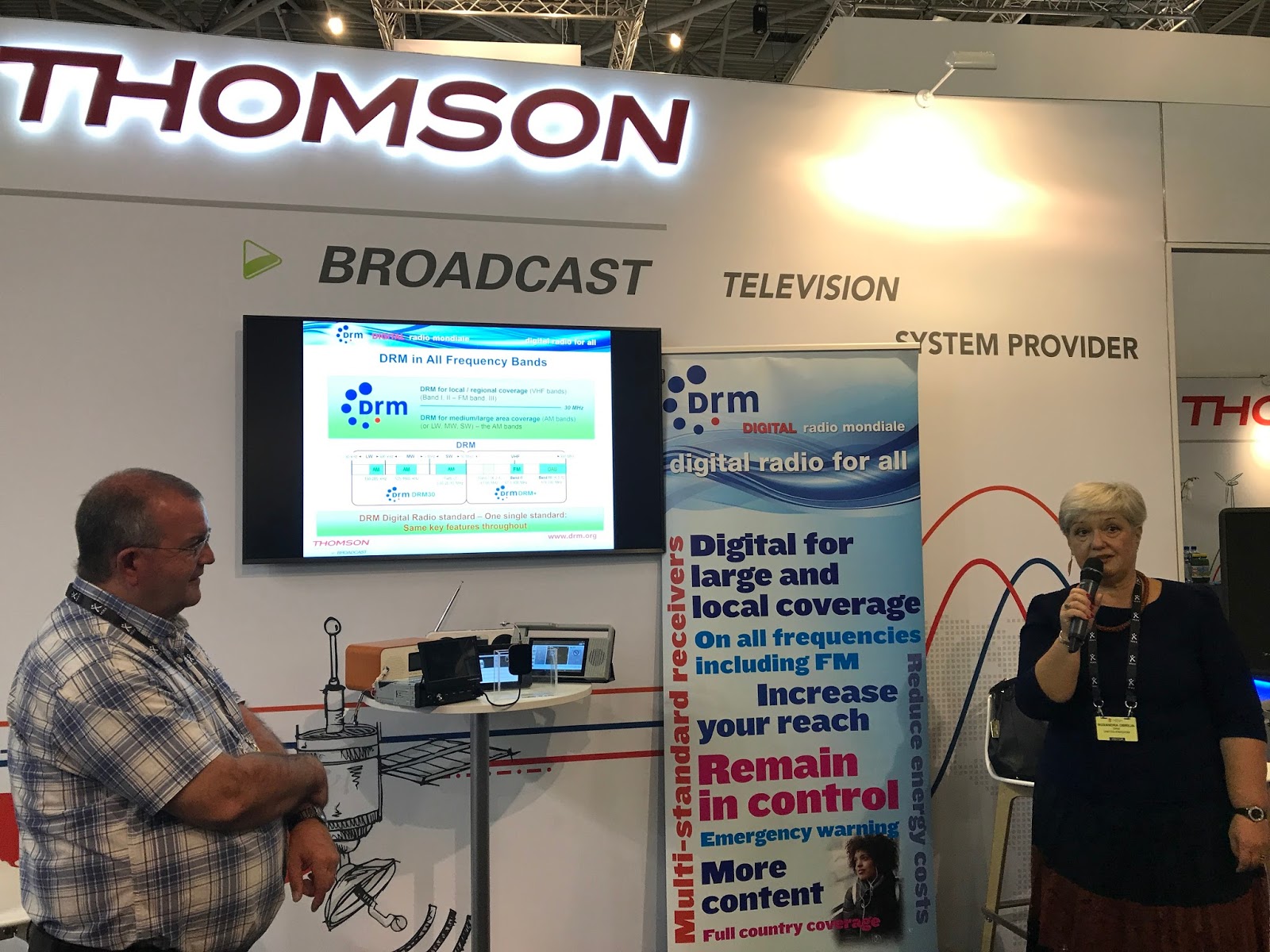
DRM is well represented at IBC at the Gospell, Thompson and Nautel booth!
Below you will see the new GR-227 (displayed on car entertainment system) GR-216 (which I am currently testing) and other photos of DRM activities. And of course, there is our Ruxandra! Thanks to Haochun for the photos.


Monday, September 4, 2017

Gospell in-car SDR DRM adaptor - GR-227

Here is a press release supporting the new product to be unveiled at IBC. Looks like another game-changer from Gospell. SDR for the car!

"Gospell announces the imminent release of GR-227 digital radio adaptor 
  
Chengdu, China, September 04, 2017  - A new adaptor  specifically designed for  in-car use  that simplifies digital radio on the road will be introduced at IBC by Gospell. 

GR-227 is a small, low-cost adaptor  that acts as an aftermarket add-on to car stereos receiving high-quality digital broadcast programs and data application, and serving it to the car audio system over a USB cable. Based on software defined radio technology, GR-227 is compatible with DAB, DAB+, DRM and is DRM+ ready. It is also powerful enough to support digital audio decoding such 
as extended HE-AAC (xHE-AAC).   

GR-227 literally works with any kind of car stereos with a USB port. Our patent pending technology allows the adaptor to behave like a thumb drive when plug into a USB port and makes it compatible with most of the music players not only in car but also for home use. 

To make the most of GR-227, the Gospell Smart Tune App for Android has been included to add more features. When partnered with an Android powered car stereo, the App not only allows for playback of the broadcast audio program but data application which brings much fun to car entertainment.   

By connecting the supplied triple band active antenna which can be attached to the windscreen through the SMA antenna connector, the reception in DRM, FM and DAB bands can be significantly improved, offering maximum flexibility between different broadcasting standards. 

Installing the plug-and-play GR-227 adaptor to your car is easy and doesn’t require changing your car  stereo. It  is one of the easiest ways to upgrade your car  radio  to digital without replacing anything. 

The Gospell’s aftermarket car adaptor range starts with USB model but more will follow to support more car stereo types. 

Haochun Liu,  DRM director, Gospell, said: “By leveraging SDR, we can now combine multiple broadcasting standards together to offer flexibility and cost advantages, coupled with easy installation without the necessity of buying a new car stereo as in traditional solutions.”   

For additional information, please visit  www.goscas.com  or contact Gospell sales at linx@gospell.com

About Gospell 
Founded in 1993, Gospell Digital Technology Co Ltd (GOSPELL). is a private hi-tech enterprise with R&D, manufacturing, business consultancy and planning, trade, delivery, project implementation and after sales service, acting as a complete DTV and triple-play solution provider for Digital TV/OTT 
related projects. Headquartered in GOSPELL INDUSTRIAL PARK at Chenzhou, Hunan Province for CPE related production manufacturing, GOSPELL also has its office in Shenzhen for business/marketing management and administration, in Chengdu for R&D and headend/transmitter system production/debugging and Customer Service Center, and in 12 cities in China as well as international offices in India, Africa and Mexico."

Thursday, July 13, 2017

The Gospell According to Terje : Chapter 1

Our intrepid DRM Evangelist Terje has written up the first operational review of the forthcoming Gospell GR-216. Give it a read here. We are lucky to have Terje on the case. His DRM experience as a real-world listener and engineer is unsurpassed!

Monday, April 24, 2017

Further updates on the Gospell GR-216


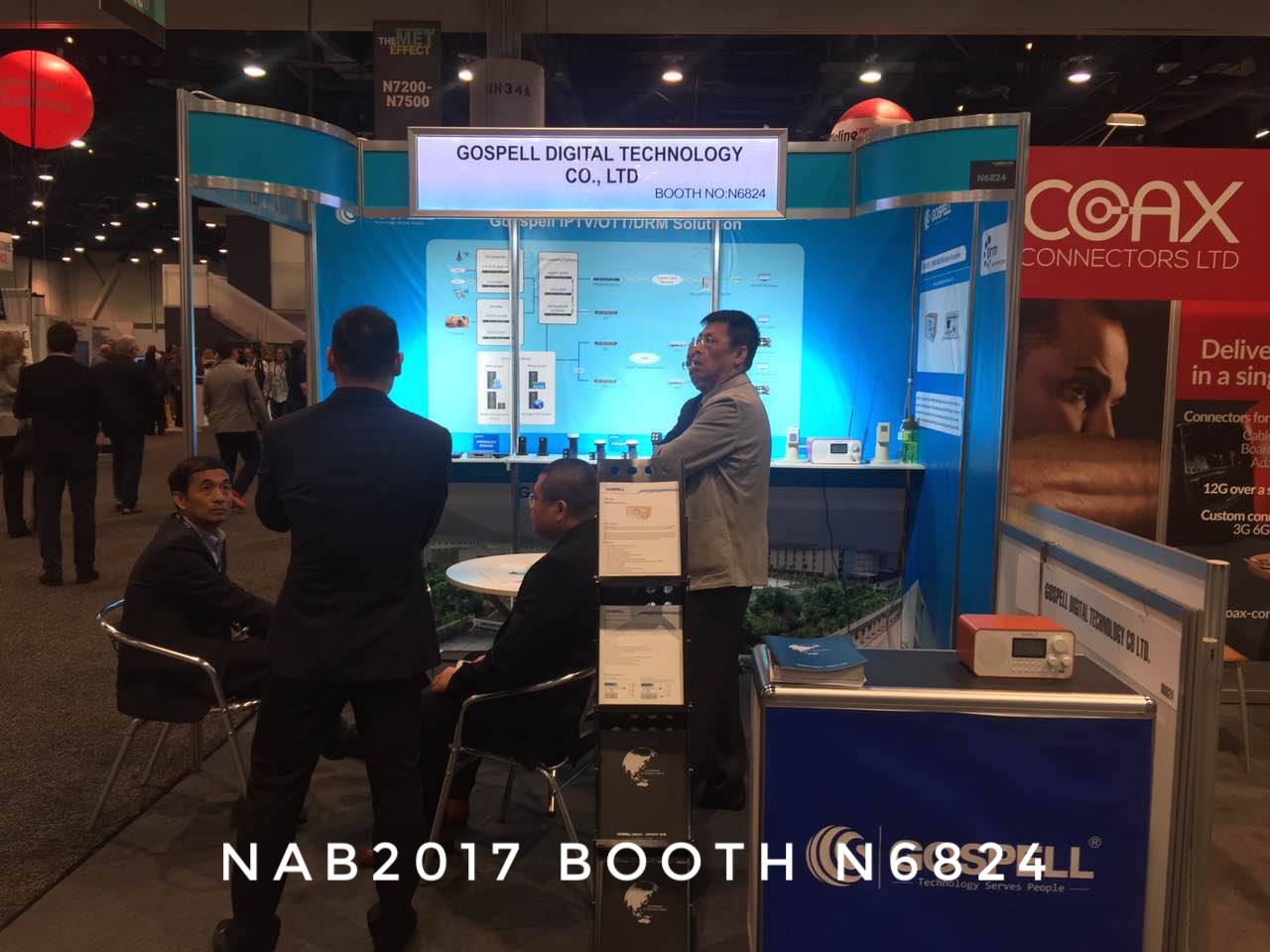
I've had further correspondence with Haochun of Gospell about the arrival of the GR-216. It is currently being shown at the Gospell booth at NAB in Las Vegas, April 22-27 2017 [Visit them! Gospell Digital Technology Co., Ltd. Booth: N6824]

Additional details (from questions I posed):

 "The internal antennas (whip and ferrite bar) are active antenna design. The market position of GR-216 is a consumer radio so SSB is not in the scope and not on our road map."

"...we are working on a "pro" version of GR-216 which is capable of doing... multimedia content as well as Journaline. By the way, the development Journaline for GR-216 is on the way and will be available in a future firmware update."
Here is the current promotional PDF flyer. Haochun indicates they are part-sourcing now, preparing for production. This looks like a really solid desktop radio. Perfect for the enthusiast, yet designed with simple operation for the typical user.


Monday, March 20, 2017

Engineering Radio Blog advocates for DRM30

Paul Thurst and a few others (in comments) make nice comments about the new era of broadcasting including DRM30. Of course, we at DRMNA agree! Check out Engineering Radio and leave a comment. Grassroots DRM30 advocacy!

With the PantronX Titus2 and the Gospell GR-216 on their way, we should have some affordable receivers soon. Will there be any broadcasts left to to listen to?

Monday, January 23, 2017

Gospell GR-216 update

Here is an update per a 23 January 2017 email from Haochun Liu of Gospell:

"The GR-216 development is in progress, the hardware part is almost finished and now we are focusing on software. We are expecting a small quantity trail production by March..."

Friday, September 9, 2016

Gospell GR-216 receiver at IBC 2016 in Amsterdam

Just a sneak peek. I think the new style is quite attractive and I can already tell that the larger, multi-line display will be a significant improvement.


Wednesday, September 7, 2016

Gospell releases new DRM receiver

As promised, Gospell has entered the DRM market with a good looking new receiver! It is assumed that the development of this device is riding on the backs of previous DRM sets such as the Newstar and the Uniwave.

Product Overview:

The Gospell GR-216 is the new generation DRM receiver designed for the purpose of low-cost access to high-quality information. Reasonable price and high performance for price-sensitive market is the design concept of GR-216.

The GR-216 has been optimized for reliable reception in harsh radio environments. The excellent receiver sensitivity allows extended service quality. Built-in active antenna with two external inputs improves the reception performance compared to the similar products with only passive antenna. The potential risks of environmental interference have been reduced by the combination of excellent receiver dynamic range and band-pass filter.

Key Features:

  •DRM/AM (MW/SW) and FM stereo reception
  •DRM xHE-AAC audio decoding
  •DRM scrolling text message
  •DRM emergency warning reception
  •DRM program recording and playback on USB pen drive
  •DRM alternative frequency switching
  •DRM reception logging for reception performance evaluation  
  •DRM expert mode for reception status inspection with DRM channel/service information
  •FM RDS station name display
  •15 station memory presets
  •1khz step tuning allows fast, precise station reception by tuning at 1khz intervals
  •Auto scan tuning/memory scan
  •Dual alarm clock function lets you set the alarm for two different wake-up times with buzzer or radio stations

Full specifications here.

I'm trying to get an interview about this one, so stay tuned.

Monday, February 22, 2016

The Gospell (sic) according to Newstar

Good News (pun intended)!

We received word today that Newstar has been acquired by Gospell Digital Technology Co., Ltd. Note that the following text includes "Gospell will continue on DRM development and business."

Here is the text of the official news release:

Dear Newstar Customers,

We are pleased to announce Newstar Electronics has recently been acquired by Gospell Digital Technology Co.,ltd. Patents and technology of Newstar will be transferred to Gospell. This acquisition will further enable Gospell to leverage best practices and look at new opportunities in the digital radio receiver market.

Gospell Digital Technology Co.,Ltd. (GOSPELL) is a private hi-tech enterprise with R&D, manufacturing, business consultancy and planning, trade, delivery, project implementation and after sales service, acting as a complete DTV and triple-play solution provider for Digital TV/OTT related projects.

Gospell will continue on DRM development and business.

For more information on DRM technology and products, please email liuhc@gospell.com
For more information about Gospell, please visit www.gospell.com

This is the end of our journey with Newstar, but we are on to new adventures.  The management of Newstar would like to thank you for your past business and long time support. We look forward to these new opportunities and to working together in the future.

Sincerely,
Chengdu Newstar Electronics Co., Ltd.
HC Liu
CEO