Showing posts with label HCJB. Show all posts

Sunday, May 27, 2018

Great fun at NASB 2018!


Good things were planned at SonSet Solutions in Elkhart, Indiana and those fine folks delivered!


Charles Jacobson served as Emcee and host for two days of fun and fellowship at SonSet, a partial continuation of the services that we all remember as HCJB. SonSet and ReachBeyond are now the heirs to this PRICELESS Shortwave legacy!


As usual, folks assembled from around the globe to discuss, reminisce and plan the future of Shortwave radio. I am always awed at the knowledge and experience of the various attendees. Representatives from all over CONUS and as far away as Asia and Europe were in attendance.

Presentations ran-the-gamut from news, receiver technology, new installations, antennas... the list goes on. Here are just a few highlights!


Charles gave an informative tour of the plant at SonSet Solutions. He then detailed projects including work with the SonSet Radio (a rather robust and efficient fixed-tuned ministry receiver).


Ever the popular presenter, Dr. Kim Andrew Elliott presented Digital Broadcasts on Analogue Shortwave Transmitters. He is the producer of "Shortwave Radiogram" and is recently retired from VOA. Dr. Elliot wowed the audience with live decodes (transmitted from WRMI and WWCR) of Shortwave Radiogram via a SonSet radio. Presentation of foreign characters (Cyrillic, Chinese and Arabic) really showed the power of this novel broadcasting technology!


Gerhard Straub Director, IBB Broadcast Technologies Division presented and engaging talk on International Broadcasting Bureau Shortwave Projects with continued good news about our CONUS powerhouse in Greenville, North Carolina.


Jerome Hirigoyen of Telediffusion de France (TDF) offered details of the 360-degree Rotatable Antenna System known as ALLISS. I'd take one for my house, but the neighbors might complain!


NASB is known for excellent food and our dinner at "Das Dutchman Essenhaus" in Middlebury, IN (an Amish style restaurant in the middle of Amish country) was tasty and great fun.

Of course, if you are reading this blog, you want to know about DRM! Well the news was plentiful and I'd call it GREAT! Both George Ross of TWR and yours truly presented on DRM topics.


George had more news about the Titus II receiver. It is nearly ready from prime-time and will be using Fraunhofer MMPlayer. This is great news and should make for a very versatile receiver. Although there have been numerous false-starts with the release of the Titus II, it is nearing release and is still promised at the sub $100 price tag.


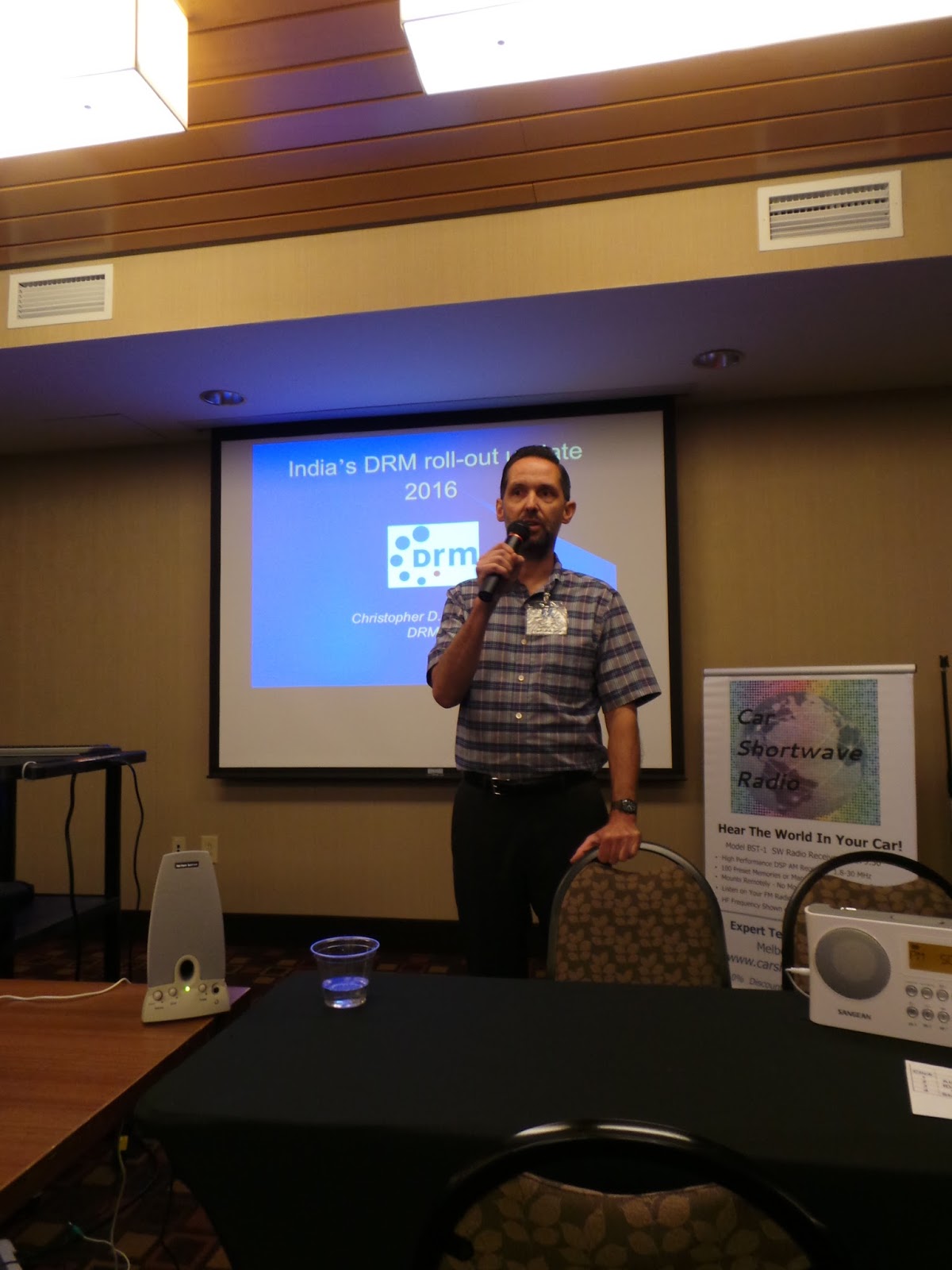
In "fly catching mode" I am seen here presenting the DRM global update  and extolling the virtues of the Gospell GR-216.


After my presentation, we moved to SonSet's hamshack to attach the Gospell to an external antenna. We were then treated to an hour of nearly flawless reception of Radio Kuwait in DRM stereo! It was really a joy and attendees that had never experienced DRM were awestruck at the audio quality and signal clarity from so far away.


NASB members gave brief reports about their efforts. Of particular interest is the work that J.D Tayloe of Strategic Communications Group shared regarding reviving an old KOL Israel site.


The business meeting handled NASB elections and plans for 2019. The location wasn't finalized but should be shortly. Stay tuned! Another great NASB conference! Thanks to the host, SonSet Solutions for another memorable and informative meeting!

Tuesday, June 7, 2016

HOWDEE! Big fun at NASB 2016 in Nashville

Way back as a kid, I learned from Minnie Pearl on Hee Haw that there is nothing quite like Southern Hospitality. My Nashville experience was wonderful. The NASB folks (with local hosts World Christian Broadcasting and WWCR) really put on a nice conference.

Sessions were interesting and varied. DRM was well represented and the subject of much between-session conversation.

Below is my brief recap of sessions during the 2 day, shortwave industry broadcaster's conference held at the Hampton Inn Vanderbilt Westend in Nashville, Tennessee...


Day 1 - June 2nd, 2016:

Opening remarks from Charles Caudill, NASB president.

Kevin Chambers on Madagascar World Voice.

Panel discussion of HFCC with experiences from Brisbane, Australia.

Tribute to the late Mother Angelica by Glen Tapley of WEWN.

Dr. Dowell Chow on additional languages from AWR.

George Ross from TWR Guam with some exciting DRM updates and info on HFCC DRM tests. It seems the Newstar DR-111 recieved the best test broadcast decodes of the receivers in use (Newstar, Avion, Uniwave).

Yours truly presented a DRM update on India and a demo of the BST-1 car shortwave adapter.


Day 2 - June 3rd, 2016:

Ray Robinson and Rev. John Tayloe on KVOH and the new broadcasts from Lusaka and future work on MW from Israel.

Charles Jacobson gave the history of HCJB and a beautiful tribute to his father, the shortwave legend Herb Jacobson. HCJB is now SonSet Solutions and Reach Beyond Australia.


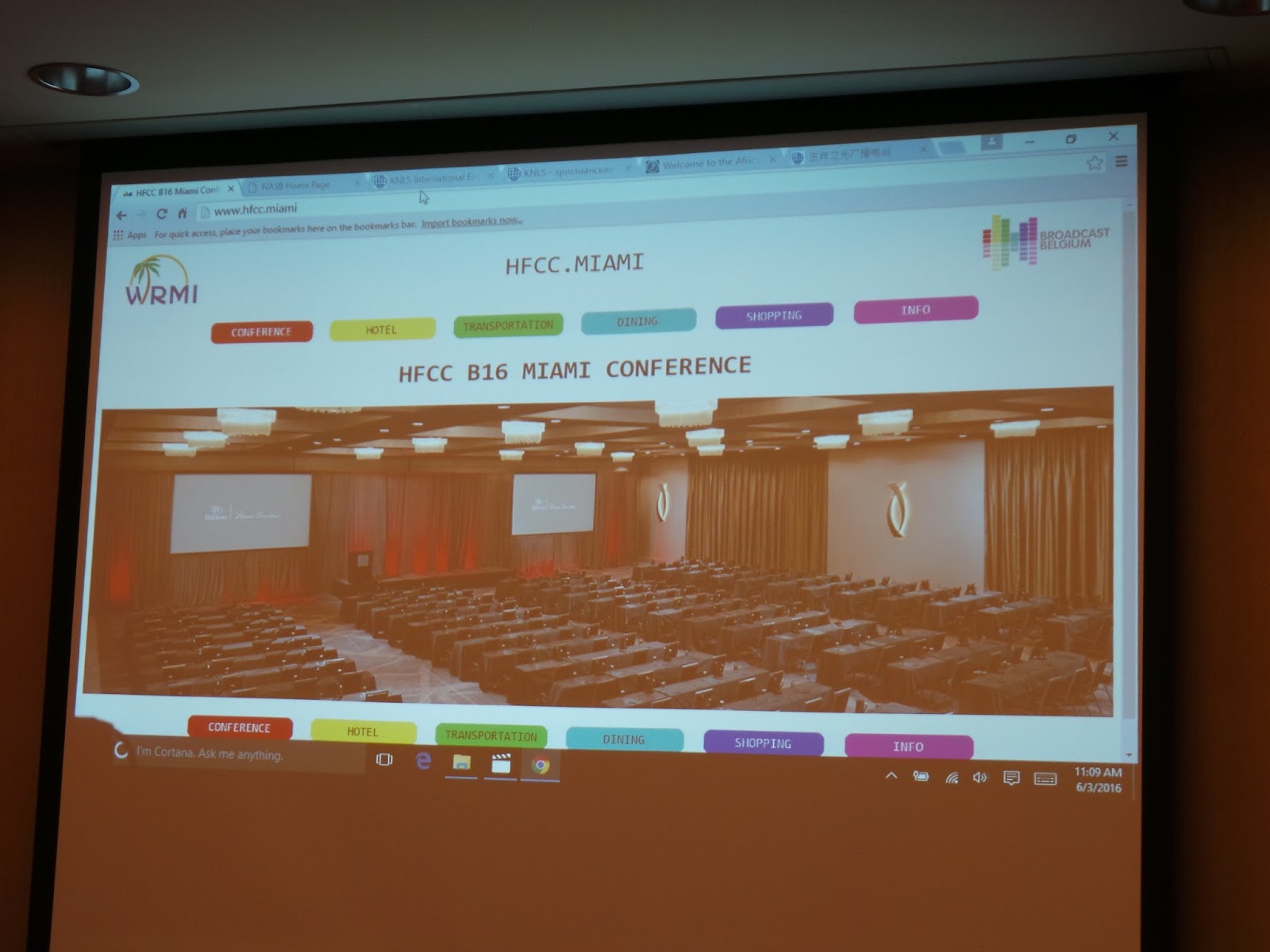
Ludo Maes of Broadcast Belgium gave us a preview of HFCC Miami this August.

There was an announcement that NASB 2017 will be sponsored by KVOH and held in Simi Valley, California.

As normal, the NASB members made me (and the other enthusiasts) feel welcome and part of the group. The famous DRM aficionado Zyg and I were treated to a private tour of WWCR by Brady Murray. Thanks Brady!

I even won a ticket to the Grand Ole Opry! Martina McBride and others serenaded a packed house.

Thanks to all of the participants and members that made this conference possible.


Friday, July 11, 2014

HCJB Australia is now Reach Beyond Australia, and they have DRM plans!

I had the distinct pleasure to interview Derek Kickbush, Media Manager for Reach Beyond Australia, previously HCJB Australia. Their website is here. Their new website, due this month, will be here. Additional photos are here.

Derek, What are Reach Beyond Australia's plans for DRM?
·         Reach Beyond Australia is taking a “gently does it” approach to DRM broadcasting.  We have the liberty of time being on our side as the only country taking up DRM within our licensed international area is India.  This country made the decision some years ago to convert their domestic MW/FM and international radio services to DRM. The process has already begun and they have a completion date of 2017.  It is a big project for India so we will monitor how the changeover progresses.  In many cases it is not so much a changeover at present but as an additional service where the same programs are being carried on multiple platforms.
  
What equipment will you use?
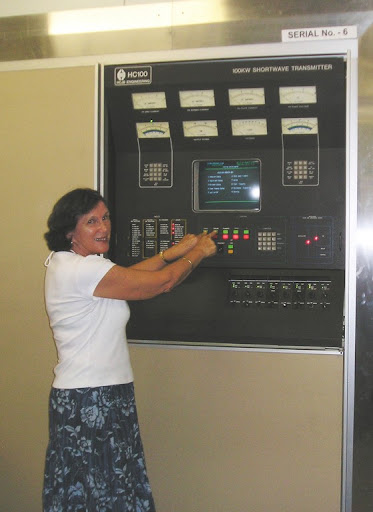
·         At present there are plans for only one HC-100 transmitter to operate a DRM service.  This 100KW transmitter is currently undergoing conversion and upgrade at the Reach Beyond Global Technology Centre (Center ha!) in Elkhart, Indianna.  It is expected to be DRM / Analogue switchable. 

·         Our current antennas will serve us well for India as the whole transmission site at Kununurra, Western Australia has been upgraded.  HF antenna options are a narrow beam parabolic reflector which originally served in a different configuration with HCJB in Quito, Ecuador.  It is currently configured for 16 and 19 metres.  Another option is a 2x4 dipole antenna for 19 and 25 metres. [That’s 2 wide by 4 high].  Finally we have a 4x4 TCI611 which is our LF antenna and operates between 6-12MHz or 49 to 25 metres.

 What is the most encouraging news you have heard about DRM?
·         The more countries that take up the DRM system the better.  Currently the big players are India, Russia and Brazil.  I saw recently where trials have taken place in South Africa.  These large audience countries ensure that the technology, wonderful as it is, is likely to survive in a forever changing technological world.  Operationally one of the encouraging features of DRM is that is not as power hungry as an analogue transmitter attempting to achieve a similar target and signal strength.  Estimates say it is in the range of 30-40% of the analogue use of electricity which is a huge saving given the rising cost of power today. Naturally being able to broadcast and be received with a near FM quality signal is every shortwave operators dream.  

What is the most discouraging news you have heard about DRM?
·         It has to be about the availability of receivers - or lack of them.  When a country such as India is considered it is absolutely essential that for the benefits of DRM to be appreciated across the population, receivers must be priced within the reach of the masses.  There seems to have been a Mexican stand-off between broadcasters and set manufacturers about who should go first when in reality there is a need for both to work together.  As DRM is adopted by the high population countries it will encourage set manufacturers to become more confident – and with mass production the price will fall.  Current DRM set prices will only be afforded by the wealthy or the radio enthusiast.  And into that mix also comes the situation of sets which are multi-system capable such as DAB and DAB+.

What is your timeline for regular DRM broadcasting?
·         Perhaps late 2016 into 2017 depending on the availability and take-up of DRM sets within India.

Does shortwave remain a viable media in general, especially for the mission field? 
·         The phrase ‘viable media’ is possibly open to interpretation and it will depend on the objectives of any individual broadcaster.  There is no doubt that governments are winding back their transmission hours or leaving the field altogether to replace it with other technologies.  It was interesting to note that several large broadcasters such as the BBC immediately increased shortwave broadcast hours into Thailand during the recent military coup.  Countries which are under some form of repression, or who have been freed from repression are often found to have large numbers of shortwave sets.  Let’s take another look at the term ‘viable media.’  Viable by what criteria?  In the west we are a very results driven society so the inclination is to only be interested in the bottom line.  We have a need to quantify everything and look for a return on capital invested.  The Christian shortwave operator has a different perspective because there is often no reliable method to gain the information required to make bottom line judgements.  When much of your audience, say in Myanmar, is operating at a subsistence level, they are not about to call a number, write a letter or SMS to a radio station overseas or sometimes even a local contact.  They have far greater issues with which to contend – but it does not mean they are not listening or even responding.  It is just that it is not happening in the way that more advanced societies think it should happen.  ‘Viable’ is often clinging on to the crumbs of information that come our way from time to time.    

·         In terms of the Christian mission field which is the reason Reach Beyond Australia is into shortwave, it remains a viable media, at least for the present.  Together with FEBC, TWR, IBRA, Adventist Radio and ourselves there are still many hours of shortwave broadcasting happening within Asia Pacific, our part of the world.  But there is no doubt shortwave broadcasters are being more selective in where and when they broadcast – almost what we might term ‘niche marketing.’  In part that comes down to the considerable cost of power and infrastructure – but also because new technologies are available and have been adopted at the expense of shortwave in some countries.  Also, as far as Christian broadcasters are concerned, there is a view to engage with ethnic language groups rather than a more generic approach to a whole country.  For Reach Beyond Australia it is about ‘reaching those unreached people groups with the gospel’ and ‘reaching those who have little exposure to the gospel.’

What are you currently doing on shortwave?
·         Reach Beyond Australia is currently on air for 75 hours per week in 26 different languages.  Our priority audiences are India, Myanmar and Japan but we also have programs for Vietnam, Nepal, Bhutan, China, East Malaysia, Indonesia and wherever English is spoken across Asia and the Pacific.  Many of the programs are produced ‘in-country’ as the producers are aware of hot issues but also because they best understand the language, customs and culture.  This makes for more effective program content.

Wow Derek, lots of great information here. Thanks for your time. In conclusion, is there anything else you'd like DRMNA readers to know?
·         Reach Beyond Australia is but one part, and a fully autonomous part of Reach Beyond around the world.  After 83 years, the mission changed its name in 2014 from HCJB which were the call letters of the organisations first radio station in Quito, Ecuador – The Voice of the Andes – established on Christmas Day, 1931.  The shortwave station commenced broadcasting from Australia in 2003 when it took over the South Pacific service which had originated in Quito.  Within a few months South Asia, South East Asia and East Asia was added to the schedule.  It will be interesting to see how the DRM component develops over the next few years.  With the increase in signal quality I suspect different types of programs to the current stream will be the order of the day.

Thank you Derek for such an informative interview!

Sunday, August 12, 2012

HCJB plans DRM to India

I'm not sure there will be any broadcasts in DRM to other parts of the globe, but Christian broadcaster HCJB sees India as viable target for DRM listeners.

"DRM will be invaluable for broadcasting to places such as India, a country of 1.2 billion people, where the digital technology has been adopted as the nation's main communication network to the rural masses. "In spite of the giant leap forward of other technologies, shortwave broadcasting still has at least a medium term future in South and Southeast Asia," added Derek Kickbush, program manager for HCJB Global-Australia." 

Complete article at Alokesh Gupta's RADIOACTIVITY.

Wednesday, March 21, 2012

NASB and DRM USA Annual Meeting


National Association of Shortwave Broadcasters, Inc.
and DRM USA Annual Meeting
The 2012 Meeting will take place May 10 and 11, 2012 at the headquarters of Radio Free Asia, 2025 M Street NW, Suite 300, Washington, DC 20036 USA.
Speakers will include:
Adil Mina of Continental Electronics and the DRM Consortium Steering Board, who will have the latest news from the DRM General Assembly in London which takes place in late March and the NAB Convention in mid-April, as well as the latest information about DRM receivers.
Charles Jacobson from the HCJB Global Technology Center in Indiana, who will provide updates on DRM conversion of HCJB's HC100 shortwave transmitters, DRM tests and evaluation with which HCJB is helping in Ecuador, the DRM diversity receiver project at LeTourneau University.
Full info available here. Any DRMNAers able to attend? I'm looking for a reporter to publish a DRMNA post!

Saturday, November 13, 2010

Le Tourneau DRM Receiver

Check out this video. By pure coincidence, I met Cam Nichols [KF7KIH] on a local ham radio repeater.

Cam was the project coordinator for this Le Tourneau DRM receiver project. It was a cooperative research project between HCJB, Le Tourneau and Rockwell Collins. I'm hoping we can get Cam to write us an article on his experiences working on this project!

Here is a PowerPoint presentation about the project.

Friday, November 5, 2010

Alan Shea: An Open Source Hardware DRM Radio

DRMNA.info is very fortunate to feature here an article written by Alan Shea, DRM enthusiast and broadcasting professional. Take his challenge to heart. What can YOU do to help Alan's dream become a reality?

Wednesday, November 3, 2010

Stephan Schaa and the Pappradio

A drmna.info exclusive! Stephan Schaa talks about himself and the Pappradio!

For the first time in English, Stephan talks about his interest in radio, his involvement at HCJB Germany and his legendary and innovative Pappradio. He also tells us where he thinks DRM and DRM portable receivers are going.

Monday, October 25, 2010

Pappradio


HCJB Germany has developed the Pappradio. It is near the magic $100 pricepoint and looks to be the perfect hobbyist RXer. Check out the specs. I'll post North American ordering information when it becomes available.