Showing posts with label receiver. Show all posts

Saturday, March 8, 2025

Affordable DRM receiver to be made in India


From the DRM Consortium website: 

Solar Grove Solutions a leading innovator in consumer electronics based in Florida, USA, known for making accessible devices, has just announced the commencement of manufacturing its All-Band (MW, SW, VHF – FM) Analog and Digital Radio Mondiale (DRM) receiver model N88 in India. This is a significant step towards delivering cutting-edge technology at accessible prices to a global audience.

The N88 is developed in close collaboration with CML Microcircuits (UK) Ltd, renowned for their expertise in mixed-signal integrated circuits, and Alongside Tech, LLC (USA) that is providing design and application development. Douglas Gregson from Alongside Tech, a recent member of the DRM consortium, says that “this revolutionary radio boasts four key, game-changing differentiating features. They are: small size, low power consumption, as N88 it extends the 3x AA battery life, low cost and seamless integration with a dedicated Android app opening the way to data applications and additional features.

“We are incredibly excited to bring this innovative DRM radio to market, manufactured right here in India,” said Mr. Templeton, CEO of Solar Grove Solutions. “This project is a testament to the power of international collaboration, combining the expertise of CML Microcircuits and Alongside Tech with Solar Grove Solutions’ commitment to delivering exceptional products at accessible prices. Our partnership with Shemish Grove Solutions India Pvt. Ltd., our affiliated company in India, has been instrumental in making this vision a reality.”

For the DRM chairman N88 is “the kind of product made in India for Indians. It is thus fulfilling the DRM Consortium vision of offering a new kind of digital radio services at affordable prices, in line with the policy, ambition and tastes of each individual country adopting DRM.”

Wednesday, May 15, 2024

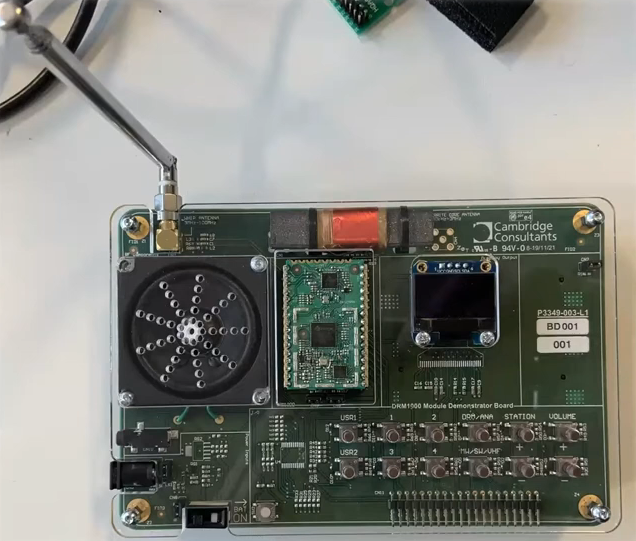
CML Micro & Cambridge Consultants DRM1000 chip

The newest press release here (the older press release is here). This is the chip Gospell is using in its new portable, the GR-221 (available soon). This looks to be a real game-changer due to it being an all-in-one solution,  having low power consumption (30+ hours on 3 AA batteries, including the possibility of a solar powered and cranked models) and its affordable cost (<$20 USD). It should yield a whole new crop of receivers that will be ideal for the burgeoning Asian DRM markets of China, India and Pakistan. Now all we need to do is to convince the North American shortwave broadcasters that the time has come for regular DRM broadcasting. Mouser plans to stock the chip soon. This novel DRM solution debuted at BES in February of this year.


Monday, March 15, 2021

New StarWaves DRM receiver spotted

No info beyond what is here. We reported awhile back that there would be some StarWaves product to come. This one may hit the magic USD 50 mark at some point. Time will tell!

Wednesday, March 10, 2021

RedwoodComm RWC2010B Digital Radio Tester

I had the pleasant opportunity to spend an hour on Zoom with Kevin Park and Darby Cho, Principal Engineers of RedwoodComm. 

From their website:

"RedwoodComm is a professional developing company for wireless communication test solution. RedwoodComm develops and provides measurement system for R&D, mass-production of broadcast system and wireless communications such as DAB, DRM, RDS, NFC, BT and LoRa. We will keep making every effort to be the best company of test & measurement system based on technical know-how and experience of test & measurement system for wireless communications."

Awhile back, I discovered their RWC2010B Digital Radio Tester online. After making contact, Darby set up a Zoom meeting. The tester unit is a powerful DRM/DRM+, DAB, DAB+, AM/FM, RDS/RDBS receiver testing device. It handles all the DRM settings and functions as well as the ability to test the new xHE-AAC codec.

You can quickly see its features on their YouTube playlist. In the presentation they gave for me, the unit was paired with the Gospell GR-216 receiver. Adjustments to the DRM parameters are easy to perform. I was impressed at how quickly the radio would switch to the  new settings. 

The RWC2010B is a flexible device for receiver testing but also a great way to demonstrate the various settings and configuration options of DRM. I can easily see how hardware or software developers, equipment manufacturers or broadcasters could easily test and demonstrate the highly adaptive DRM platform. In the near future, I hope to be able to post more details and some hands-on reviews. 


If you are interested in more information, you can email them an inquiry or use their information form


Wednesday, September 16, 2020

Hope springs eternal with DRM receivers

Please take a look at this slideshow showcasing the progress being made on the DRM standalone receiver front. A few new ones here that look interesting. Particularly interesting to see Korean manufactures back in the game. I think that marks a first since the demise of MSWay 9 years ago.


Tuesday, June 9, 2020

New crop of DRM receivers from Gospell

I got this email today:

"Glad to hear that you're on the market for DRM Radio Receiver,we are a professional manufacturer in China, hoping to establish business relationship with you. In my following email, we recommend some of our hot selling products for your reference."

Accompanied by this link

HaoChun Liu @HCLiu11 (who should be familiar to many DRM enthusiasts from his work at Newstar and Gospell) showed off a few of these sets in Twitter teasers earlier in the year.

We reviewed the GR-216 several years back. I have no further information on these new sets, other than what I have seen on Twitter. I'm always glad to see new receivers on the market. Several of these are even battery powered, which is great news.

Thursday, November 28, 2019

Fraunhofer and China pen xHE-AAC & Journaline MOU

Read the article here but the meat of it can be found in this quote:

"The MoU is based on long-term mutual trust established in previous collaborations, and aims to further develop the cooperation with regard to the open terrestrial DRM standard, including technologies substantially developed by Fraunhofer IIS, such as the xHE-AAC audio codec and the Journaline text service. In addition, the two parties will intensify their exchange of information on DRM technology, work on jointly promoting DRM technology, conduct workshops on DRM technology, and conduct field trials to successfully drive the deployment of DRM in China."

It would appear this will simplify the process for DReaM and other receiver software solutions to use xHE-AAC, which has been long-term point of contention with DRM enthusiasts. Moreover, I think this act solidifies China's commitment to DRM. Could this act break the log-jam of affordable receivers?

20191204 CLARIFICATION: Brother Rafael informs me that the xHE-AAC is only a problem for the compiled Windows version of DReaM, the binaries already do contain the codec. He indicates that programmers are needed (not paid, just willing souls) to build Windows compiled versions.


Tuesday, May 21, 2019

StarWaves all-in-one DRM module announced

As reported at NASB 2019, a new DRM module (W102) with integrated hard coded baseband decoder will be available from StarWaves.

The module will be suitable for applications such as consumer radios or aftermarket automotive solutions. The module contains a high-quality tuner frontend and audio DAC as well as a digital input for external audio sources e.g. from an external MCU to provide Bluetooth or USB audio.

It measures only 40x40mm and covers all bands from LW, MW, SW to the FM Band (64-108 MHz) in DRM and analogue radio. All data services such as Journaline or MOT Slide Shows can be extracted from the data stream for further processing in the target device. The module can be ordered and will be available in the 3rd quarter of 2019.

DRM Consortium Press Release here.

Saturday, March 9, 2019

Receiver demonstrations at DBS 2019

Here we see a quick demo and information shared by Alexander Zink of the DRM Consortium at this week's ABU Digital Broadcasting Symposium held in Kuala Lumpur. He describes that the Gospell GR-216 is using the NXP automobile chipset. We see and hear the Titus II but without further details. Still waiting!

Friday, January 18, 2019

More receiver details from BES 2019

All presented by a smiling Mr. Alexander Zink, VP of the DRM Consortium.

Thanks to Brother Alokesh for the tip about this video!

Wednesday, January 16, 2019

New DRM standalone receiver at BES?

I have been given an anonymous tip that there will be a new receiver unveiled at BES 2019 in India. Inntot Technologies is an Indian company. This appears to be another SDR with DRM decoding capability. I am hopeful we will get some details from attendees.

It would be cool if this one pushes the price-point down. India and China are the markets to watch! I'll be hunting around for an interview opportunity with these guys.

Monday, May 21, 2018

CONUS-wide Gospell GR-216 review!

Special thanks to Haochun of Gospell for the demo unit. As you will read below, we really put it through its paces. Haochun allowed us a test unit and this single radio was all over the USA in states from the West Coast to the East Coast in 6 months.

We were particularly fortunate to present the demo unit at NASB 2018 at SonSet Solutions in Elkhart, Indiana. Kuwait DRM came through for a solid hour on two frequencies from 7000 miles away! Here is a short clip as an example. If this doesn't convince you that we have a winner here, then nothing will!


It is a pity there is so little DRM available in North America. After our experience with Kuwait, the consensus is that the GR-216 works well overall and very well with DRM (remember, this is an early release with early firmware) and I believe it represents hope that tabletop DRM reception is now within reach!

Fibber:

I have been taking my time to enjoy the new GR-216. The unit is a full featured table top with traditional AM and FM offerings plus Shortwave and DRM (for AM and Shortwave bands). Build quality is really nice. It is a solid feeling radio, with a crisp looking LCD display. It sports BNC connectors for antennas and RCA and 1/8" jacks for audio output. It has a physical switch for using internal versus external antennas.

I'm going to quickly cover AM and FM reception. Here in the Pacific Northwest, DRM is just about non-existent currently. Shortwave reception is fair this time of year so here is an example of daytime VOA Korea.


On a quick trip to the Oregon coast, I caught this Classical music station transmitting full RDS. Nice to see the scrolling text descriptions on such a nice, bright display.


I did have several brief opportunities to compare signal levels on DRM brodcasts. Kuwait and Romania both presented on the radio, Kuwait with bits of audio. I ran these concurrently with a recent build of DReaM and found the Gospell comparable to what I was getting via the ELAD FDM-S1 using DReaM.

I must say that the variable AM bandwidths have quickly become my favorite feature. The wide settings are more than generous for high-fidelity listening. The medium and narrow settings provide the ability to avoid adjacent squawk in even the overcrowded 49M bands on my West Coast mornings.

If I had any suggestions with would variable AGC options for AM and possibly speaker modifications as the AGC seems to on-occasion clamp and then release on deep fades to big signals, causing physical speaker distortion or almost rattle even. No doubt some of the problem is simply a firmware adjustment.

This is by far the most stout and robust feeling DRM receiver I have encountered. Once the price-point approaches that of conventional (but high-quality) tabletops, we will have a global winner here. xHE-AAC compatibility on DRM too, so this one will be ready for my Global DRM Domination plan!

BRENDAN:

First Impressions: after the box arrived, I carefully pulled out all of the contents and studied the radio itself. Larger and heavier than the DR111, it has a sturdy plastic case and knobs. A separate 110V power supply with Euro-style pins had been sent along, but a pin adapter fixed that issue. Plugged it in and was greeted by the radio as it booted up. It worked!

But what kind of radio is this? Is it a geek's radio or a consumer's radio? It's a bit of both actually. You can choose to just set and use the memories and be happy, or manually tune it and listen to DX. With both internal antennas and BNC connectors for external ones, you can choose to use it as a tabletop receiver in the kitchen or living room.  Think of it this way: the looks of an MW/FM receiver, with a decent HF SDR receiver inside.

Build quality is something I'd like to talk about before my operating observations. The case is sturdy, but the knobs and buttons need a better mechanical foundation. They are wiggly when they're not supposed to be and feel cheap. The sub-assembly that the front control buttons are attached to is not very strong, since a single button push would move them all within their casing holes. All controls actually worked fine, so the electrical aspect was good, just not the structural assembly. The main tuning knob is used for several functions just like the DR111, but it too needs some work. It often overtunes (too fast), even in 'slow' mode, so manual tuning has to be carefully done, and the detents in the knob's action don't help either. There is an extensive frequency/channel memory system built-in, but I did not use it.

Operating the radio, I found not all controls to be entirely obvious, nor did the instruction booklet provide much help actually. I still don't really know what "VF/VM" means, outside of perhaps meaning "Visible Frequency/Visible Memory." Never did function that I could tell...

However, most of the other control functions were easy to understand and/or figure out, so I was able to get it working reasonably quickly. Analog FM reception is quite good, and I was pleased at the fringe reception results for my location. The GR216 has a good speaker, and you can separately adjust the treble, midrange, and bass using the button control commands, a neat touch (no extra knobs). Stereo outputs are available on the back plane, so you can connect the radio to an ouside stereo system. A 3.5mm headphone jack, 2 RCA connectors for both channels, and power inputs.

Analog MW/AM operation was very straight forward, and proved to be quite good with external antennas connected. The internal antenna was not that good in my experience, due to AC hum like I have not heard in years. The FM band was only somewhat affected by the hum, but the MW/AM band was virtually useless. Not even the local MW stations located only about 5miles/8Km away completely overwhelmed, making listening very difficult. Connect an external antenna and the noise disappears, WITH the same power supply. Hmmmm...

HF analog reception was good, especially with an external antenna connected, but the internal rod antenna was not that effective for HF purposes.

A very neat feature that works on all modes is what appears to be an automatic filter bandwidth  setting, and it works well. I could set the radio to FM, tune a local station which would then show a wide(r) bandwidth, while moving to what is a DX station showed a narrower width. Very effective, even on HF.

While I could not 'catch' any DRM signals during my review period, I have no doubt that the GR216 would work well, based on my previous experience with my own DR111. I would also rate the GR216 as a better all-around radio than the DR111, given the higher quality speaker and more refined operating controls.

In summary, I found the GR216 to be a good consumer-oriented radio. The bells and whistles that we enthusiasts like are there, but this is a radio even my 88 year mother could use once set up. She is not a tech whiz, and has difficulty with a smartphone, and I do cut her a lot of slack (she is my mother, after all!). For most people, this radio will be enough for them, and it certainly would be for my mother.

A good effort, now make it smaller!

MEL: 

My reception of DRM has always been with a ham transceiver (Flex 5000) and DREAM software which meant I had to boot up a computer and load software. With the GOSPELL, power up is immediate and ready to receive. For me, this was nice.

As we know, there isn’t much DRM available now due to poor propagation and the loss of stations on this continent. But I was able to decode the State of Kuwait well here in the Midwest. A couple times I decoded a few words from Radio Romania International on 6030 kHz. The GOSPELL displays the sending stations transmission parameters including SNR which tracks within a few dB of what DREAM reports.

There was little difference in the decoding sensitivity between the Flex/Dream and GOSPELL. The dropouts are handled eloquently with soft fade out/fade in vs. the more abrupt off/on of DREAM. Audio fidelity was very good. The front firing speaker was great and headphones worked well using the rear “socket” connection.

Functionally, all the controls and memories worked as described in the GOSPELL user manual. Programming the memories was not real intuitive (stores up to 20 frequencies across 5 banks) but I soon got use to storing/recalling them. The radio’s confirmation “beep” is not set as a default but I believe would make memories easier to use. The two alarm timers are very loud so no fear of missing a scheduled time to listen!

For antennas, I used a “ham bands only” Yagi and 52 foot vertical. There are separate BNCs jack for connecting both FM and AM(DRM) antennas. I found the whip antenna adequate for medium wave and some shortwave listening and great for local FM stations. I did very little listening on AM shortwave, however the sensitivity/selectivity was good for the bands I scanned. Both slow and fast tuning is available on 15 bands (530 through 26100kHz). Status of the AM signal is given too. At the push of a button RF level in dBuv, frequency offset/bandwidth in kHz and carrier modulation in percentage is displayed.

It’s 12 push buttons appear to be physically mounted on one inside panel. All these buttons slightly wiggle when any one is pushed as if they were “loose.” This may be by design, however to ensure they will never stick. They have good tactile feel so I do not believe there is any reason for concern.

I had one issue with the radio. The display froze once on the station it was receiving (in this case, “Galeni TX1”) and I could no longer change frequencies or recall memories on DRM. This was easily fixed using the radio’s “Reset” command but at the sacrifice of losing all presets and memories.

Would I buy one? Yes, I would. The radio has good aesthetics would look fine anywhere in the house and it sounds great. Thanks to Fibber for loaning me the radio to try out.

ZYG:

The radio doesn't have an attenuator but I did try the BW settings. As I have not seen the schematic or even a block diagram of the receiver the following is only speculation on my part.

The radio needs a wide band IF filter to allow for the 10 kHz DRM signal. This IF filter appears to have a fixed (non-adjustable) bandwidth, and the adjustable menu BW filter appears to affect only the audio, as the adjacent strong station splatter can still be heard at the narrowest BW setting.

 A good test for a MW receiver during the day, here in the metro Atlanta area, is to tune to 50 kW station WSM 650 kHz in Nashville, Tennessee, 308 km away from my house. With an outside long wire antenna the station can be heard by a good receiver, even though there is an adjacent local 50 KW station WGST on 640 kHz (31 km away). The radio in my wife's car (Subaru, Forrester) can clearly pick up WSM, without splatter during the day, in our driveway with just the stock car antenna! Similarly, during the night hours with a good receiver I can receive 50 KW station CFZM 740 kHz near Toronto, Ontario, Canada, without adjacent channel splatter even though the adjacent channel of 750 kHz is occupied by local 50 KW station WSB (25.5 km away).

The Gospell can hear WSM with the long wire but unfortunately underneath the very strong splatter of WSB. The same occurs with CFZM. As for shortwave, I compared the GR-216 using its internal telescoping whip antenna side-by-side with my Tecsun PL-880 using its telescoping whip. I find the Tecsun to be a little more sensitive than the Gospell.

Friday, September 9, 2016

Gospell GR-216 receiver at IBC 2016 in Amsterdam

Just a sneak peek. I think the new style is quite attractive and I can already tell that the larger, multi-line display will be a significant improvement.


Wednesday, September 7, 2016

Gospell releases new DRM receiver

As promised, Gospell has entered the DRM market with a good looking new receiver! It is assumed that the development of this device is riding on the backs of previous DRM sets such as the Newstar and the Uniwave.

Product Overview:

The Gospell GR-216 is the new generation DRM receiver designed for the purpose of low-cost access to high-quality information. Reasonable price and high performance for price-sensitive market is the design concept of GR-216.

The GR-216 has been optimized for reliable reception in harsh radio environments. The excellent receiver sensitivity allows extended service quality. Built-in active antenna with two external inputs improves the reception performance compared to the similar products with only passive antenna. The potential risks of environmental interference have been reduced by the combination of excellent receiver dynamic range and band-pass filter.

Key Features:

  •DRM/AM (MW/SW) and FM stereo reception
  •DRM xHE-AAC audio decoding
  •DRM scrolling text message
  •DRM emergency warning reception
  •DRM program recording and playback on USB pen drive
  •DRM alternative frequency switching
  •DRM reception logging for reception performance evaluation  
  •DRM expert mode for reception status inspection with DRM channel/service information
  •FM RDS station name display
  •15 station memory presets
  •1khz step tuning allows fast, precise station reception by tuning at 1khz intervals
  •Auto scan tuning/memory scan
  •Dual alarm clock function lets you set the alarm for two different wake-up times with buzzer or radio stations

Full specifications here.

I'm trying to get an interview about this one, so stay tuned.

Tuesday, August 23, 2016

Titus2 "Digital Playout Solution" in its natural habitat

Thanks to George Ross of Trans World Radio / KTWR Guam for a few photos of the Titus2, caught in the wild at HFCC 2016 Miami! George is on the right in the second photo.


TWR presents the Titus II DRM radio at HFCC!

The PantronX Titus II is actually a full SDR solution in a boombox case. Few details yet, but it is running Android, has a 100 kHz to 2 GHz receiver on-board and decodes AM, FM, SSB and DRM natively.

It uses a Quad-Core ARM A53 @ 1.2 GHz, 1 Gig of RAM and 8 Gig of on-board Flash. 7" TFT display and supports Android 5, 6 or custom remixes. See the promotional PDF here.

It sports some hardware buttons and the back-stand folds under to cover the TFT for safety and storage. This unit also facilitates the Filecasting concept we have reported about before. It can even be used as a WiFi hotspot, to rebroadcast data it has received to other local mobile devices.


This looks like a real winner and I am anxious to see a demo unit! Thanks to George at TWR for the heads-up. More details to follow.

Monday, February 22, 2016

The Gospell (sic) according to Newstar

Good News (pun intended)!

We received word today that Newstar has been acquired by Gospell Digital Technology Co., Ltd. Note that the following text includes "Gospell will continue on DRM development and business."

Here is the text of the official news release:

Dear Newstar Customers,

We are pleased to announce Newstar Electronics has recently been acquired by Gospell Digital Technology Co.,ltd. Patents and technology of Newstar will be transferred to Gospell. This acquisition will further enable Gospell to leverage best practices and look at new opportunities in the digital radio receiver market.

Gospell Digital Technology Co.,Ltd. (GOSPELL) is a private hi-tech enterprise with R&D, manufacturing, business consultancy and planning, trade, delivery, project implementation and after sales service, acting as a complete DTV and triple-play solution provider for Digital TV/OTT related projects.

Gospell will continue on DRM development and business.

For more information on DRM technology and products, please email liuhc@gospell.com
For more information about Gospell, please visit www.gospell.com

This is the end of our journey with Newstar, but we are on to new adventures.  The management of Newstar would like to thank you for your past business and long time support. We look forward to these new opportunities and to working together in the future.

Sincerely,
Chengdu Newstar Electronics Co., Ltd.
HC Liu
CEO

Wednesday, September 16, 2015

Avion receiver in use at IBC 2015 in Amsterdam

This video tells the story! Now, when do the rest of us get our hands on one? The BBC broadcast via Babcock seen/heard on the video sounds great. Will this "Made in India" receiver be the tipping-point for DRM worldwide? We shall see and we can hope.

Sunday, May 24, 2015

DRM developments at NASB 2015 in Washington DC


I have just returned from an excellent two days at NASB 2015 in Washington DC, hosted by RFA with on-site host Al "A.J." Janitschek

I was pleasantly surprised by the volume of DRM30 discussion this year. North American shortwave broadcasters are ready for DRM!


It was the 25th annual meeting of the NASB so Continental helped us celebrate with cake!

Specifically, there were three talks that featured DRM prominently. Below are just a few of the overall conference highlights:

Lauren Libby, President of TWR gave an impassioned plea for DRM receivers and for us to look to DRM for the future of international shortwave broadcasting. TWR trialed a DRM feature to Japan on KTWR Guam where they received a positive response from Japanese enthusiasts. 

On Friday, Cal Carter of Continental Electronics presented updates from the DRM consortium including the current status of the large scale Indian initiative as well as positive momentum in the Asia-Pacific region, Brazil and Southern Africa.


Of course, I took a crack at sharing the excitement by presenting my experience as a listener and logger. I enjoyed showing examples and playing audio from the user's perspective. I explained and demonstrated the strengths of DRM using Terje's DRM-Log Plotter software. My slides here and the audio clip here. I presented a reception time-capsule video at NASB 2014 which you can view here. Thanks to Terje for the great DRM-Log Plotter handout.

Here is a music sample from RNZI, recorded via DRM at my home in Oregon. That is about 7000 miles from their 25kW transmitter and received on my Newstar DR111 using an alligator clip-lead to a basement drain pipe as an antenna. Isn't DRM amazing?

We were very fortunate to have Jerome Hirigoyen in attendance from TDF. Their site in Issoudun, France currently has 2 high-power DRM transmitters in operation.
Dr. Kim Andrew Elliott presented VOA Radiogram and encouraged broadcasters to participate in the Radiogram initiative. VOA Radiogram is a weekly program whereby textual news with images can be transmitted on traditional, unmodified shortwave transmitters and likewise received using off-the-shelf, unmodified shortwave radios.

Gerhard Straub from IBB gave a worldwide update about their broadcast sites. Gerhard also indicated there will be an RFP out soon to develop an end-user app for decoding VOA Radiogram on smartphones and tablets. More info to follow on this exciting development!


During the NASB business meeting, the conversation got very interesting. A significant number of the broadcaster members showed interest in using DRM (sooner rather than later) and working together to make affordable receivers (USD 50 or under) available. This conversation was augmented by audience members including Ludo Maes from Broadcast Belgium and his extensive DRM knowledge. I was really excited to finally get to meet him, having enjoyed years of his work with TDP Radio and The Disco Palace on DRM.
I'm sure that attendees will agree, this was an enjoyable and informative gathering. For me the opportunity to "talk shop" with shortwave broadcasters and enthusiasts is unsurpassed. To those I met for the first time and for those I have known, it was my great pleasure to be in attendance.
As I flew home, I snapped this gorgeous view of Mt. Hood near Portland, Oregon. It was a perfect way to sum up my trip - "the sky is the limit" for DRM in North America. I would like to thank the NASB, RFA and all those in attendance for making this such a great conference. Special thanks go to Dr. Elliott for serving as my local host. It made my trip even better!

Sunday, December 21, 2014

Avion receiver due January 2015

Rafael heard from Mr. Agrawal that we can expect the new Avion DRM receiver in January!

Merry Christmas & Happy New Year to all DRMNA readers!