Showing posts with label BST-1. Show all posts

Tuesday, June 7, 2016

HOWDEE! Big fun at NASB 2016 in Nashville

Way back as a kid, I learned from Minnie Pearl on Hee Haw that there is nothing quite like Southern Hospitality. My Nashville experience was wonderful. The NASB folks (with local hosts World Christian Broadcasting and WWCR) really put on a nice conference.

Sessions were interesting and varied. DRM was well represented and the subject of much between-session conversation.

Below is my brief recap of sessions during the 2 day, shortwave industry broadcaster's conference held at the Hampton Inn Vanderbilt Westend in Nashville, Tennessee...


Day 1 - June 2nd, 2016:

Opening remarks from Charles Caudill, NASB president.

Kevin Chambers on Madagascar World Voice.

Panel discussion of HFCC with experiences from Brisbane, Australia.

Tribute to the late Mother Angelica by Glen Tapley of WEWN.

Dr. Dowell Chow on additional languages from AWR.

George Ross from TWR Guam with some exciting DRM updates and info on HFCC DRM tests. It seems the Newstar DR-111 recieved the best test broadcast decodes of the receivers in use (Newstar, Avion, Uniwave).

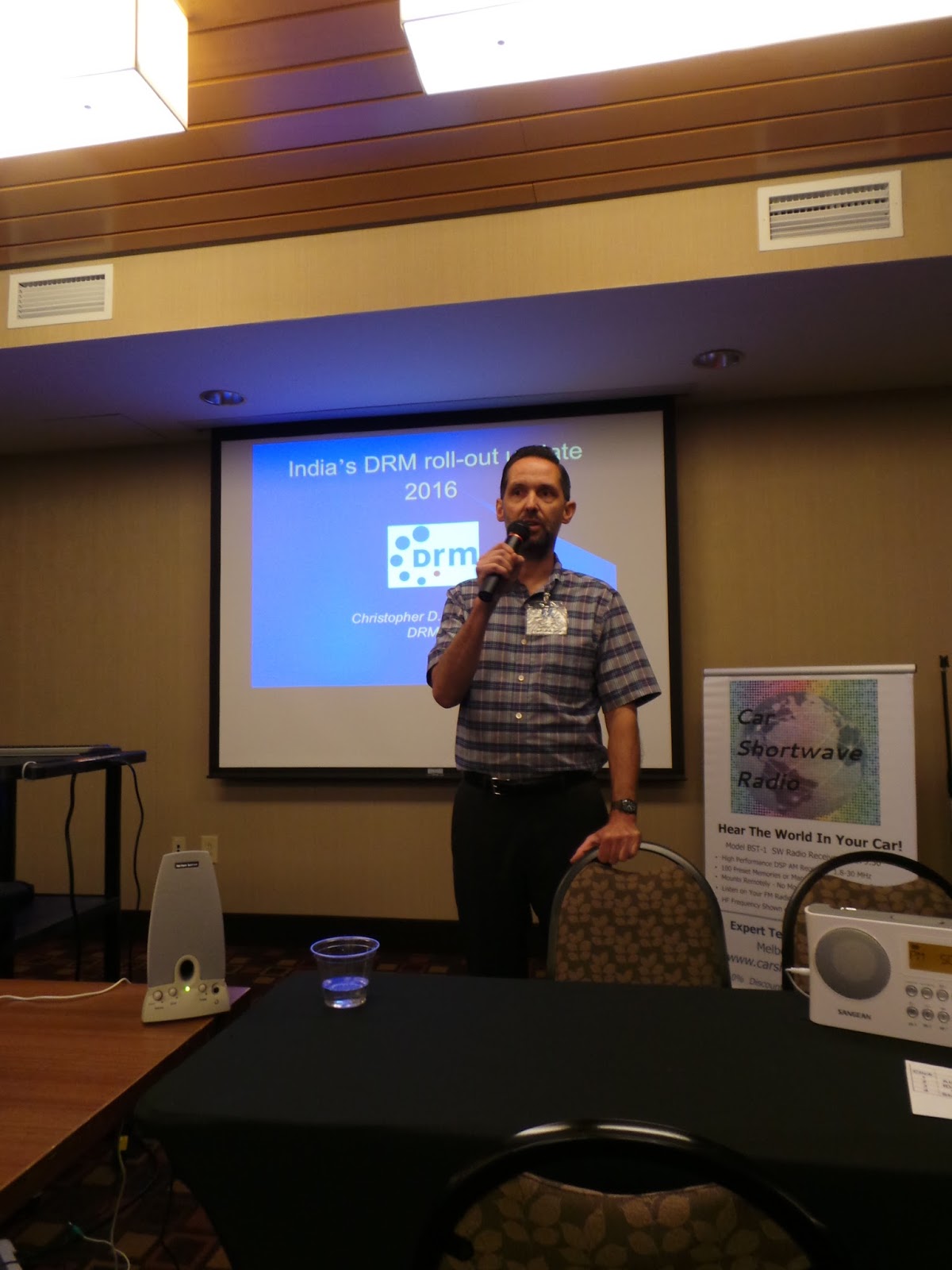
Yours truly presented a DRM update on India and a demo of the BST-1 car shortwave adapter.


Day 2 - June 3rd, 2016:

Ray Robinson and Rev. John Tayloe on KVOH and the new broadcasts from Lusaka and future work on MW from Israel.

Charles Jacobson gave the history of HCJB and a beautiful tribute to his father, the shortwave legend Herb Jacobson. HCJB is now SonSet Solutions and Reach Beyond Australia.


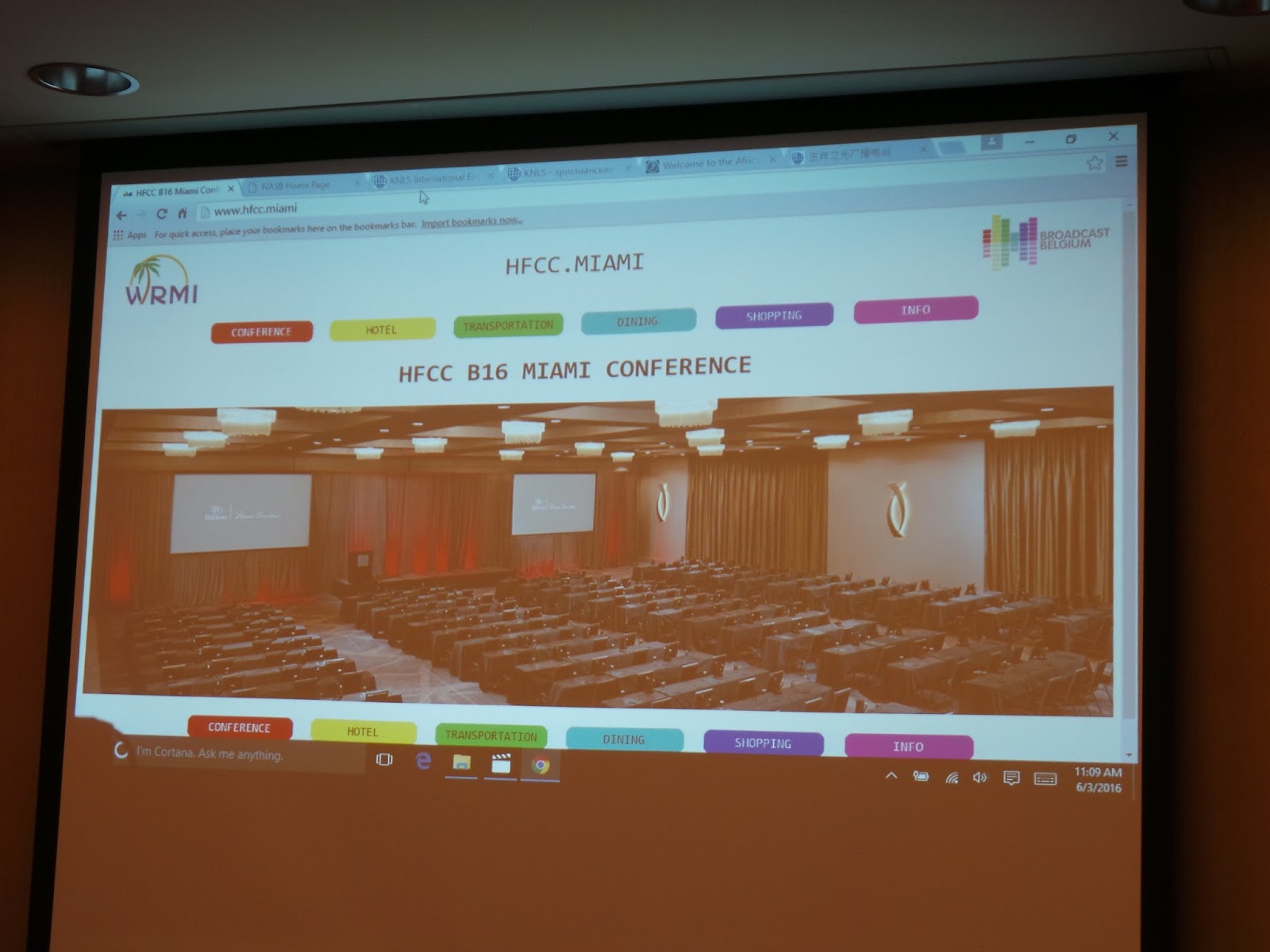
Ludo Maes of Broadcast Belgium gave us a preview of HFCC Miami this August.

There was an announcement that NASB 2017 will be sponsored by KVOH and held in Simi Valley, California.

As normal, the NASB members made me (and the other enthusiasts) feel welcome and part of the group. The famous DRM aficionado Zyg and I were treated to a private tour of WWCR by Brady Murray. Thanks Brady!

I even won a ticket to the Grand Ole Opry! Martina McBride and others serenaded a packed house.

Thanks to all of the participants and members that made this conference possible.


Saturday, April 9, 2016

Car Shortwave Radio BST-1 First Impressions

I've received, installed and played with the BST-1 in my car for the last week. Not only do I find this receiver fun listening, but the installation was a snap!

The 2 button remote takes some getting used to, but I have almost mastered and memorized the functions already. Last night I added and deleted some channels. 

Mr. Studenberg at Expert Technology Studios, LLC via www.carshortwaveradio.com was pleased to hear that I was having such success with the pre-programmed channels. The channels that come already installed in the unit are most suited to Midwest and Eastern USA. I added some RNZI outlets too.

So far, I have enjoyed armchair copy on WWCR, WTWW, WEWN, BBC, Radio Australia, Radio New Zealand International, Radio Havana Cuba, CB radio and 80M AMers. This is a kick cruising down the highway.

I don't have the benefit of the RDS/RBDS display on my dash, but I have several portables with that function. I have used them to help me program the unit. When I do, I am consistently seeing S8 signal levels on listenable stations.

Otherwise, I have been relying on my rusty CW to listen to the audible frequency output. This is simple to pick up, even for a tin-ear CW operator like me!

The simple trunk-lip mount antenna is available from www.carshortwaveantennas.com and is highly recommended. It is short, attractive and easy to install. Just for fun, I tried several CB and ham whips with a magnetic mount base and they worked ok too.

I have experimented in the past with shortwave reception on the road. This is no easy task. Electrical interference from the car and surrounding buildings and vehicles is a serious problem when using a portable radio. The BST-1 almost completely eliminates those issues. The noise blanker and DSP circuitry work overtime to make listening while mobile a breeze. 

I'll be curious to see if the BST-1 can withstand the rigors of newer electric car interference however. If I can get access to one for a test, I'll let you know.

Although the BST-1 is not a DRM receiver, I am enjoying it day and night. I keep wanting to hop into the car and take a drive just to see what I will find. Mr. Studenberg has a real winner in this novel, simple to use and install, affordable shortwave receiver for the car.

For a better idea about the specs and functionality, take a look at the manual. The BST-1 turns out to be a really fun receiver and perhaps the ultimate mobile shortwave solution! I'll be begging him for a DRM model next.

If there is anything else you'd like to know about using the BST-1, just let me know. Read our interview with Mr. Studenberg to get the background on this exciting mobile receiver.


Thursday, March 31, 2016

Car Shortwave Receiver gets FCC approval

"(We) Finally have FCC approval for the shortwave radio for car at www.carshortwaveradio.com and can now sell it." says the email from Mr. Studenberg at Expert Technology Studios, LLC. about the new BST-1 car shortwave solution.

This is really exciting! Fred has assembled the best state of the art technology and functions into a clean product that really doesn't require "installation" per-se. Anyone attending NASB in Nashville this June can see it in action.

This is not DRM related news, but the fact is - we love shortwave! If you are reading this, you understand the magic shortwave brings. "Look Ma, no internet required!"

I will review the unit on its analogue shortwave merits soon. Suffice it to say, this is really one of the only options for mobile shortwave that offers a plug-and-play solution.


Monday, July 13, 2015

Shortwave in the car? Introducing the BST-1

I spotted this new idea via the excellent SWLing blog. Not hours later, I was interviewing the founder and developer of the BST-1 Car Shortwave Radio, Fred Studenberg. Suffice it to say, this is an exclusive, in-depth interview with the man. He certainly has the SW passion DRMNAers share. Can we convince him to try DRM on a future unit? Only time will tell! Let him know you want that capability!

Fred, tell us about your background ?

I recently retired after 37 years with Rockwell Collins, the last 20 years as an engineering group manager for commercial aircraft HF and VHF communications.  My final project was a new 400 watt HF transceiver for use in the new Airbus A350.    

I started in electronics in 1965 as a teenager.  Short wave listening was always fascinating and there is still something magical about hearing signals that arrive from thousands of miles away by reflecting from the ionosphere.

What motivated you to develop the BST-1 ?

I was on a trip to Europe and while driving a big Mercedes through Germany, I discovered that the radio had short wave coverage !   Just like on AM and FM, the same digital display provided short wave readout.  Although it only tuned the 49 meter band there were European stations on day and night.  I listened to commercial short wave, including many music stations, throughout the trip and decided I wanted this capability in my car when I returned home. 

In the past, I’d built short wave converters that went inline with the car radio antenna and converted selectable short wave bands down to some fixed AM channel, like 1550 kHz.   This required you tune the converter to get the short wave stations and of course you did not have good frequency calibration and had the unsightly converter unit in the front under the dash.

In my professional work, all our aircraft radio equipment is mounted remotely in the avionics bay and tuned by a serial data bus from some much smaller remote control or digital display unit.   I realized that the best car short wave radio solution would be one that could be mounted out of sight, away from the interference from the car’s computer systems up front and then tuned remotely and wirelessly connect to the car’s audio system in some manner.    

I explored the method of remotely tuning the short wave radio.  I thought originally that using an Apple Iphone with its nice display would be a good idea.   I planned to either use WiFi or Bluetooth from the Iphone to link to the remote mounted radio.  The radio would then Bluetooth audio to the car audio system.

I quickly discovered that method was not a good idea.  You had to look at the screen, to type or touch a frequency.  It was as bad as driving while texting.  Also, not all cars have bluetooth audio interfaces and I didn’t want to run any audio cables from the trunk to the front dash of the car.

By chance, I saw a press release from Silicon Labs in which they discussed their single chip FM transmitter with RDS capability.   Prior to that, a synthesized FM transmitter was very parts intensive and adding RDS required even more hardware plus a microcomputer to generate the message format.   Here in one chip with simple 2 wire serial interface, was a frequency synthesized FM band transmitter with RDS.    It then became clear I should have the remote short wave receiver transmit audio and its frequency information via RDS to the car FM radio. Most every car from the 1990s to date has FM radio, although not all will have RDS.   I was to later discover that while the RDS frequency readout it is a nice feature, it isn’t 100% necessary for operation of a car short wave radio with the method of tuning that I finally adopted.

Since I’d given up on the Iphone controller concept, I needed a way to get tuning commands to the remote radio.  I knew from experience that when listening to short wave at home, I just scan though the 100 or so presets that I have loaded on the portable short wave radio.  I rarely switch to manual mode and tune around.   

This gave me the idea of developing a method of control that only needed to initiate a scan of the preset channels and let the radio stop when it heard an active one.  If you didn’t want to listen to that frequency, you pressed a button to resume the scan.  This suggested that I only needed some method of getting a momentary switch closure to the remote mounted radio to start the scan.

I found that 315 MHz key fob type transmitters and simple 315 MHz super-regen receivers were available at very reasonable cost.   By having the microprocessor in the remote radio look for the unique 25 bit, 20 msec long serial data message from the key fob, it could detect when the button was pressed and start the scan.   This worked very well and it soon became apparent that I could put in more selections by having the microprocessor measure how long the button was pressed.
I ended up using a two button key fob, so I have a total of 8 different commands.    For instance, a short press of the right button starts the scan function.  Or, if you press and hold for about 1 second until you hear 1 beep from the FM radio, and then release, it toggles the scan direction up and down.  If you continue to hold the button past the 1st beep for another 1 second until you hear 2 beeps and then release, you toggle between manual tuning and preset tuning.  These are the two most commonly used functions so they can be executed easily and quickly.   

If you want to toggle the receiver bandwidth between voice and music, you hold past the 2nd beep for another 1 ½ seconds until you hear 3 beeps and then release.    Finally, to toggle the FM transmitter between 88.1 and 88.3, you would hold down for a total of about 5 seconds to 4 beeps and then release.  Other functions using the 2nd button allow single step of preset or manual tuning, Morse code annunciation of the operating frequency, quick selection of WWV, and adding or deleting frequencies from preset memory.    

All this is a long explanation of the method of controlling the remote radio and the way in which you can view the frequency display on your car FM radio.    There is much more to the story of the actual radio.

Originally, I was going to make it all modes, including DRM but to reduce the  complexity and development time for my first design I decided to make it simple and work for 99% of short wave listening, which is AM.    

While looking at the Silicon Lab’s FM transmitter, I discovered they also had a nice line of single chip receivers and some of those covered the short wave bands.    These SI lab designs are state of the art, all digital designs and provide very good performance.   They are AM only but have 1 kHz tuning increments, good sensitivity and excellent digitally based selectivity.   The bandwidth can be selected for voice or music, as required.   

The final remote radio design in the BST-1 has a RF filter and preamp operating into the Silicon Labs 4743 receiver.  This receiver chip was specifically chosen since it has a built in digital noise blanker.  A noise blanker is essential to chop out the interference from spark plugs found in all internal combustion engines.   The receiver audio then goes to the FM transmitter which has the two selectable transmit frequencies so you can always find a clear FM channel on your car radio.    The radio has all band coverage from 2.3 to 26.2 MHz.   Actually, you can use the key fob to tune from 190 KHz in the long wave band, up through the AM band all the way to 30 MHz.  However, the RF filters will attenuate signals outside the normal short wave range but you can hear stronger signals on these other out of band frequencies.  

I found that while all this hardware worked well, the major development effort was in software.  I used another Si Labs device, the C8051 microprocessor.  This processor runs the radio and decodes the bits from the 315 MHz receiver to figure out the commands, provides tuning commands to the receiver and FM transmitter and manages all the preset channels, manual tuning and RDS information.   

Give a description of the typical BST-1 setup :

You only need to locate the small remote unit in your trunk or hatch back or even under the seat of your car.   You power if from your car’s power outlet using the 10 ft long power cord.     You tune your car FM radio to 88.1 or 88.3, depending on what FM frequency is not used in your local area.    Then, just use the key fob controller to start scanning and the BST-1 will stop when it hears a signal in preset memory.  It has a very good signal detector that looks for an actual AM carrier, not just signal level, so it won’t stop on noise.   If you have RDS on your car FM radio, you can see the actual short wave frequency as well as signal level, given in “S” units from S1 to S9. An extremely strong signal, like Radio Havana on 6 MHz will sometimes move it to “S+” and when this happens a built in RF attenuator activates to reduce signal levels to prevent overloading.

What I have not mentioned is the antenna!     I originally thought of a design like some of my earlier converters, that you could somehow place inline with the car radio antenna and have the car antenna serve for both the AM/FM radio and the short wave receiver.   While this was practical in cars of the 1980’s and earlier in which you could actually see and touch the antenna connector on the back of the dash radio, it is no longer.   I would not even attempt to find the antenna connector on the radio in  newer cars.  In fact, the car radio is not even under the dash in some new cars, it is mounted remotely in other areas of the car.  The front dash radio tuning panel is connected to the car radio with some type of hard-wired serial data bus.

Since I knew I would have to use a separate “whip” antenna, I designed the input impedance of the BST-1 to work with the high impedance of such an antenna.    At HF, a 25” whip is nothing like 50 ohms and is effectively more like a very low resistance in series with a small value of capacitance, like 10 pf.    This represents high impedance, so to avoid losing lots of signal, the receiver needs a high input impedance.  Additionally, to minimize signal loss, the capacitance of any connecting cable from the antenna to the receiver needs to be as low as possible, suggesting short coax cables other than 50 ohms, such as 95 ohms.     

I’ve worked with an antenna manufacturer to make a special model of their trunk lip mounted antenna that has a short cable, about 8 feet, and uses low capacitance 95 ohm coax.   It also has the RCA antenna connector used to mate to the BST-1 antenna input.   

I’ve found the trunk lip antennas most satisfactory.  The small hex screws used to secure it to the underside of the trunk lip have a small point on them that will press through the paint just enough to provide a good ground for the coax right at the trunk lid.  This provides the shielding necessary to keep out any car electronics noise.    

Question of the hour Fred...how about DRM ?

I know DRM is a proven technology and being used by some broadcasters.  I’ve listened to DRM at home using an adapter at home on one of my SDR receivers.    With good signals, the quality is, of course much better than with legacy AM broadcasting.    The programming is rather limited but as with everything, if there is a commercial demand it will be provided.     

I’ve not done any tests with DRM in a car and would expect dropouts on the normal fluctuating skywave signals I see with the AM stations. [NOTE: Your editor says DRM works great mobile, at even 7000 miles from the 25kW txer! See these posts about mobile tests.I know in Europe there are DRM operations in the 11 meter band (which the BST-1 will cover) and in the local area of coverage with consistent high signals, I understand mobile operation is quite good.  

In conclusion, like many, I’d like to see short wave be used more in the US for general, commercial broadcasting.   The wide area coverage is quite amazing and I’ve travelled hundreds of miles while listening to the same station with virtually the same signal levels the entire trip, something that does not happen with AM or FM.    With the BST-1, I hope I’ve made it possible for more people to get short wave into their cars with minimal effort and get high quality short wave reception. 

Help Fred by voting for him in the Silicon Labs development contest HERE! Do it now!

Thanks Fred for your time and energy on this product. It certainly looks like a winner and would be a "killer app" with DRM capabilities!